What is the Business Model for AI?
With the resurgence of Artificial Intelligence (AI), it seems:
There is currently too much of a focus on feasibility (can we?)
Not much attention given to desirability (do they?) or viability (should we?)
Unfortunately, this leads to AI driven business model canvases that look like the following:

These AI business models often:
Lack a defined customer segment
Lead with “AI for ______” as their value proposition
Do not have an obvious way of generating revenue
Early stage teams still need to test their business models, especially when they incorporate AI.
For this article, we’ll use Teaser.AI, an app that looks to take the friction out of online dating, as an example below.

Teaser.AI is from the team that created Dispo, the disposable camera app that has millions of downloads and active users. The idea of Teaser.AI came from customer discovery, mostly women, who used the Dispo app. They would often complain about the ineffectiveness of online dating.
The concept of Teaser.AI is simple, eliminate ghosting for online dating and help people make better matches.
The CEO Daniel Liss explains the idea behind Teaser.AI in this Product Hunt post.
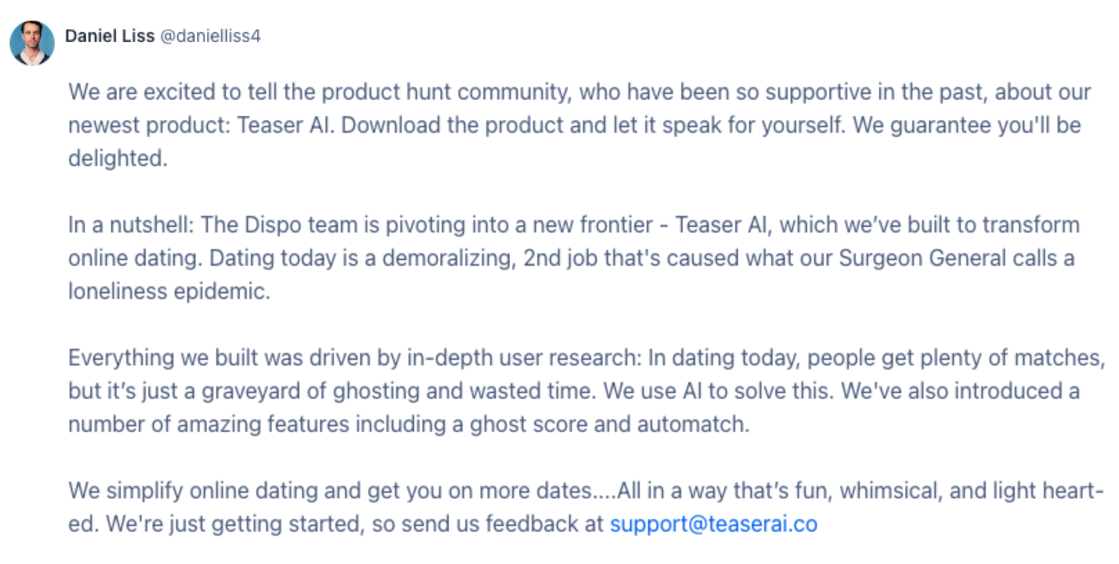
Let’s dig into the early stage business model of Teaser.AI

First off you’ll notice that Teaser.AI focuses on single people who are frustrated by online dating. These are people who are on several existing apps but it isn’t working out for them. They have endless lists of matches but rarely do any of them receive responses.
The value proposition of Teaser.AI is “Less ghosting” and “Better matches” and not the AI itself.
I find that is refreshing to see them lead with the benefits, not simply the AI.

The Channels used to reach customers and deliver value are the App Store and Social Media.

Customer Relationships are created through a concept they call a “Ghosting Score” that helps weed out the bad actors. The Teaser.AI team also uses “Verified Profiles” to build ongoing trust with their customers.

Here is where other AI startups could learn a lot from the Teaser.AI team… Revenue Streams!
They have 3 major tiers of recurring revenue:
$19.99 a week
$39.99 a month
$229.99 for lifetime access
The subscriptions unlock features to help their customers get the most out of the app, which acts like a virtual avatar of themselves to cut through the initial small talk and find a match.

On the back stage of this business model, the Teaser.AI team needs to make all of this work somehow.
The high level Key Activities are what you’d expect:
Application Development
AI Development
Marketing
Profile Curation

The Key Resources needed to make this work are things like:
App
AI
Team
Single People :)

When you think of the costs incurred to make this work, it often helps to look at the Key Activities and Key Resources.
In this case, their Cost Structure includes:
Marketing Spend
Software Development Costs
App Store Fees
Team Salaries

For Key Partners, I imagine there are many different options for the Teaser.AI team to explore. AI is such a visible space at the moment. Since they are a part of All Summer Long, Inc. I think it makes since to list them as the only one for now.
AI Needs to be Viable
This is just one example of an AI business model, but you’ll notice how it creates, delivers and captures value.
They don’t simply use “AI for_____” as their value proposition without a defined target customer.
Instead, they try to solve a problem (albeit in a light-hearted way) and provide a clear benefit to their customer base.
This approach doesn’t only apply to startups.
Whether it’s Adobe using AI to power their existing products or Mural introducing AI-powered teamwork solutions, in the end they each need to test out different business models in order to sustain.
I think AI will get there, but it’ll take a few iterations of business models along the way.
Hopefully this will give you a head start on your journey.