How Mailchimp Tested for Viability
Mailchimp was acquired by Intuit for about $12 billion, but did you know they struggled with their business model in the very early days?
Let’s look back at how they tested their way to a viable business model.
Mailchimp’s First Landing Page
Early on, Mailchimp started out as a rather unassuming landing page. However with closer inspection, you can see that they were on to something different.
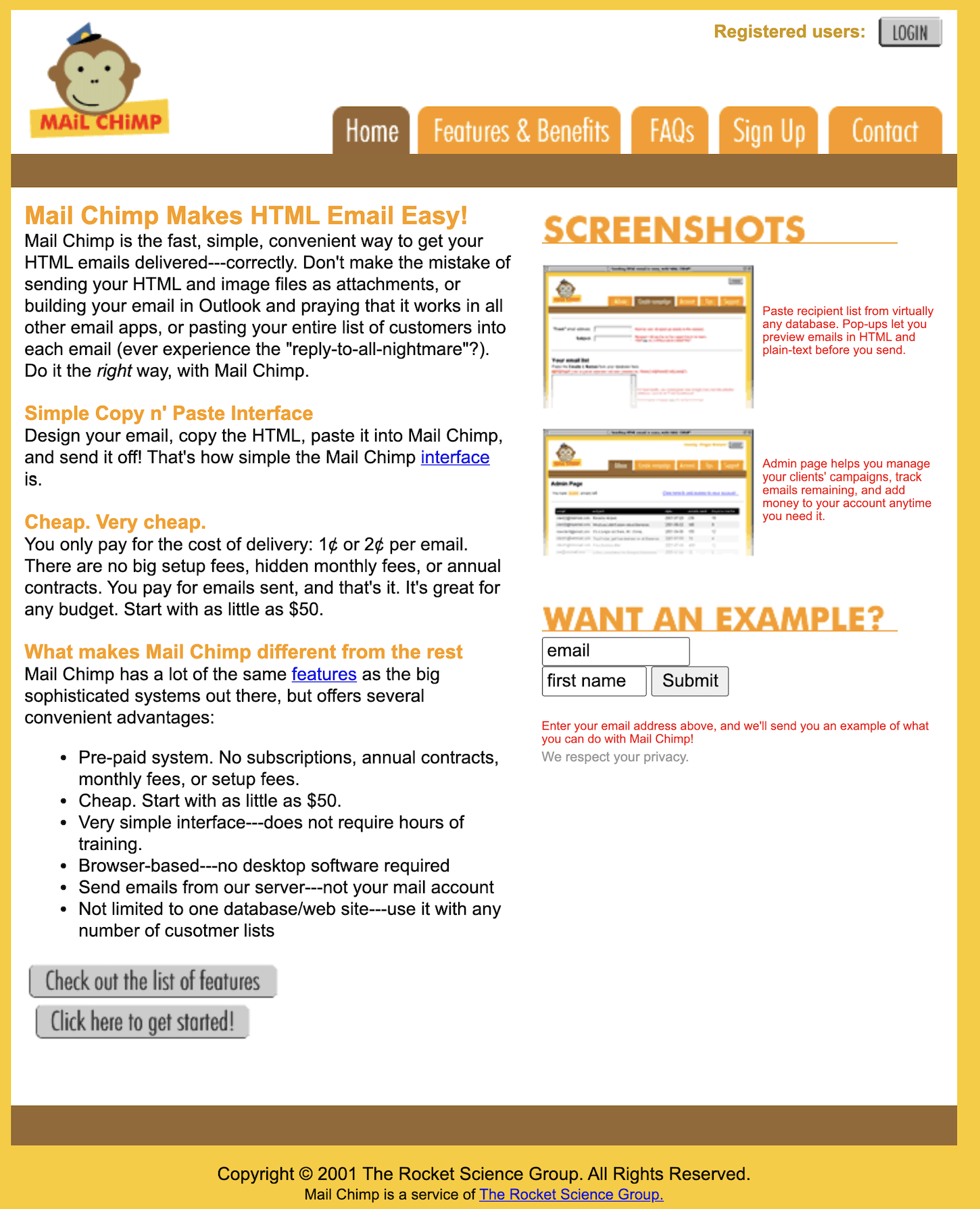
Mailchimp’s 1st landing page
Mailchimp initially targeted small business owners. It becomes apparent how deeply they empathized with them, even in this very first version of the website. The words they use in the value propositions speak directly to the concerns of countless small business owners.

Mail Chimp Makes HTML Email Easy! - In 2001, email was still a complete pain to format across different clients. All of the supporting text below this value prop expands on the pains small business owners were experiencing with email outreach.
Simple Copy n’ Paste Interface - The idea of a simple interface, even how its spelled here, speaks directly to small business owners who simply don’t have the time or skills to make it all look professional.
Cheap. Very Cheap. - Small business owners had very little money to fork over to pay for an email service. Cheap was music to their ears. We’ll touch on this topic a bit later down below.
What makes Mail Chimp different from the rest. - The rest were clunky, but well funded competitors that didn’t understand small business owners. If you made it down this far as a potential customer, there’s a good chance you were taking action.
Testing your value propositions on a landing page is a great way to determine early stage desirability. In this case, you can tell the founders already did their homework and were themselves, small business owners.
Mailchimp also had a very compelling Call to Action (CTA).
This is an important step that is still skipped by people who are testing business ideas. In my Testing Business Ideas book, I stress time and time again that you need a strong call to action or otherwise, you’ll be left making decisions based on vanity metrics.
Back in 2001, we called these “hits”. A large number of hits made you feel good inside, but you couldn’t really learn much from them.

The CTA’s for this landing page included:
“Check out the list of features!” button
“Click here to get started!” button.
“WANT AN EXAMPLE?” - all caps CTA with email and first name submission. This one is the most powerful in my opinion, as the customer can experience what the real value of Mailchimp is right away.
There were a few other clickable components of this page; the blue interface/features hyperlinks and the thumbnail screenshots, but they were less compelling.
A strong CTA with a verb that speaks to the customer is more effective.
While these help test desirability, what was Mailchimp doing early on to test viability?
Mailchimp’s Freemium Model
The founders at Mailchimp experimented with many different business models early on. Back in 2001 Mailchimp was still mostly a side project, generating a few thousand dollars a month. But when they decided to focus on it full time, it wasn’t clear how to make it viable at first.
This is a common dilemma I see across the industry. It feels quite scary to quit your day job and put all of your attention and focus into your side hustle. You have to make the idea into a viable opportunity, so that you can pay your cost of living expenses.
Mailchimp’s tests of viability varied from the pay-as-you-go model to tiered monthly pricing options.
In 2009, Mailchimp introduced their Free Plan.

It may have seemed like just another startup attempting to get users by bolting on a free plan and hoping for the best, but this was different.
The Mailchimp team had data. Quite a bit of it.
They were analyzing what worked and what didn’t each and every time they changed their business model. If you were around in 2009 and expanded the free plan box to learn more, you would’ve seen hints of it in the description.

Mailchimp was making a huge bet.
They deeply understood their customers and decided to make a calculated choice on what I call “shared risk”.
If Mailchimp customers were successful, then they would quickly outgrow the 100 subscribers max limit listed in the description. In doing so, they’d have to upgrade to a paid plan. Mailchimp founders understood that if they couldn’t help their small business owners succeed, then they wouldn’t succeed.
In hindsight, it was a brilliant way to test viability.
Once Mailchimp made this change in 2009, their user base grew from 85,000 to 450,000 in the following year. And that growth wasn’t only free users either. Their paid user base grew to over 4,000 per month!
Fast forward years later, and Mailchimp is on pace for about $1 billion in ARR alone.
Looking back, I think the introduction of the freemium model was the catalyst for this success.
Lessons Learned
If you have a side hustle and are thinking about focusing on it full time, then ask yourself the following questions:
Do you have a deep understanding of your customers?
Are you willing to experiment with different revenue models?
Does customer success relate directly to your success?
It took Mailchimp about 20 years to go from a bootstrapped side project to a $12 billion acquisition, and without a viable revenue stream, it never would’ve lasted.