Start with Learn
Why is the Build Measure Learn loop so hard to put into practice?
Because we don't start with learn.
Let me explain.
Eric Ries helped popularize applying the scientific method to business with his book The Lean Startup.
Shortly afterwards, the Build Measure Learn loop was everywhere.
But readers were not using it in the way it was intended.
People read The Lean Startup or watched a video, started building as fast as possible and then put whatever they built in front of customers to get feedback.
I'm all about getting feedback from customers, but this approach leads to a great deal of frustration on both sides.
Instead of acting on our impulse to build, we need to follow Eric's initial advice and plan things out by going through the Build Measure Learn loop in reverse.
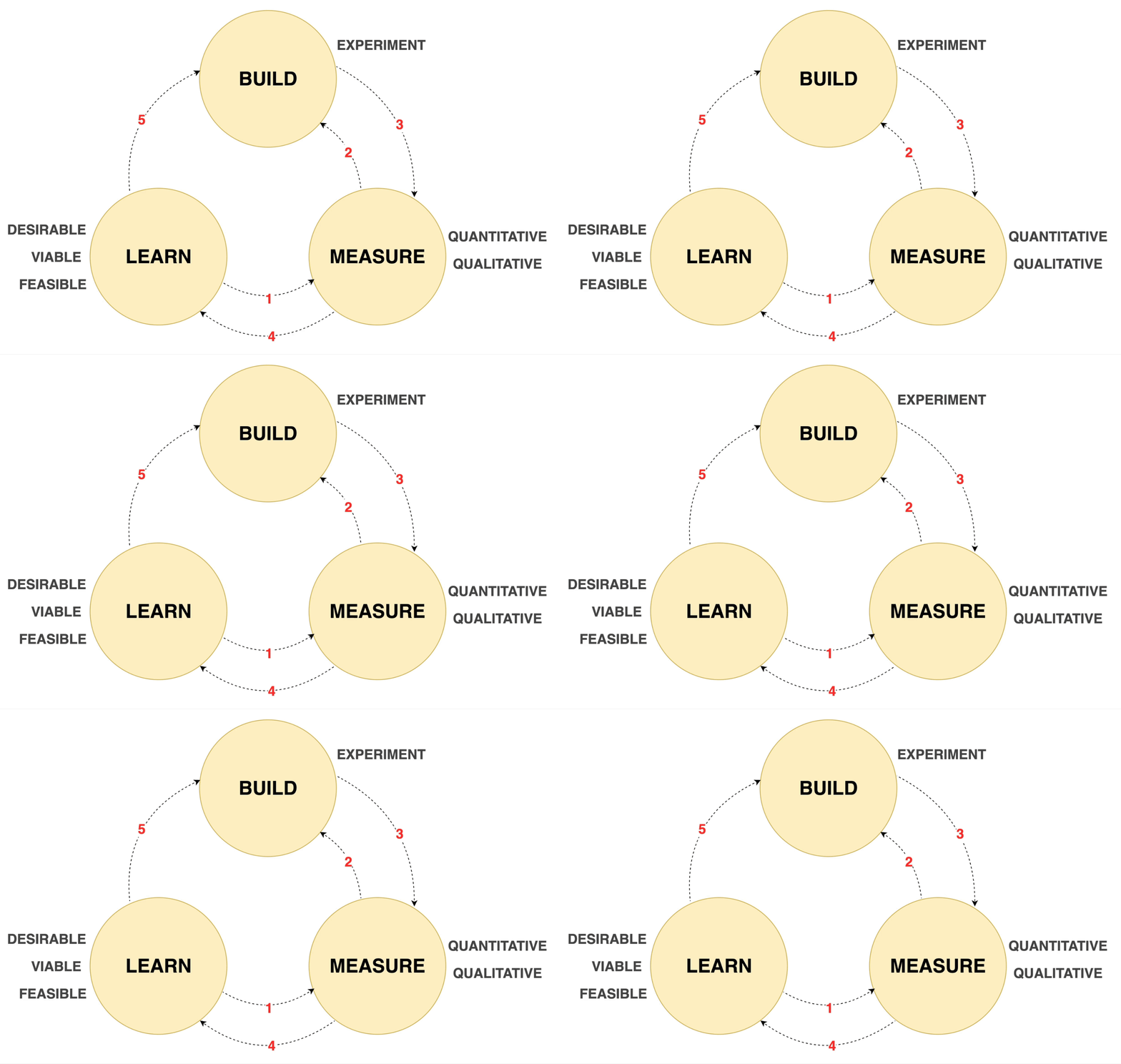
Step 1 - What do you need to learn?
What do you need to learn about the market, the value proposition, the customer jobs to be done? I ask teams to write down what they need to learn about desirability.
What do you need to learn about pricing, revenue and cost? I ask teams to write down what they need to learn about viability.
What do you need to learn about your ability to execute? Do you have the right resources and abilities? I ask teams to write down what they need to learn about feasibility.
Step 2 - What do you need to measure to learn?
This is usually a mix of quantitative (the what) and qualitative (the why) with regards to desirability, viability and feasibility.
Write down what evidence you'd need to see to learn what you need to learn.
Step 3 - Design your experiment
While I like building things, sometimes you don't need to really build much of anything to learn what you need to learn.
Instead of building, it could be doing search trend analysis or performing customer interviews. If you are further along in your journey perhaps you need to create a clickable prototype or run a concierge test.
Whatever you challenge is, chances are there is an experiment you can design to generate the evidence you need to learn what you need to learn.
This was one of my main drivers in writing the Testing Business Ideas book.
Step 4 - Run the experiment
Run your experiment and synthesize what you've learned.
Did your results support or refute what you thought you knew about desirability, viability or feasibility?
Did you learn anything unexpected?
Step 5 - Use what you've learned to make a decision
While learning is important, it isn't the end goal.
Customers aren't going to reward you for learning faster than everyone else.
You have to put that learning into action and deliver value.
They are going to reward you when you solve their pain for a price they are willing to pay.
In conclusion, before jumping to build just ask yourself, what do I need to learn?