Gil Vaisman | How I Tested ADU’s
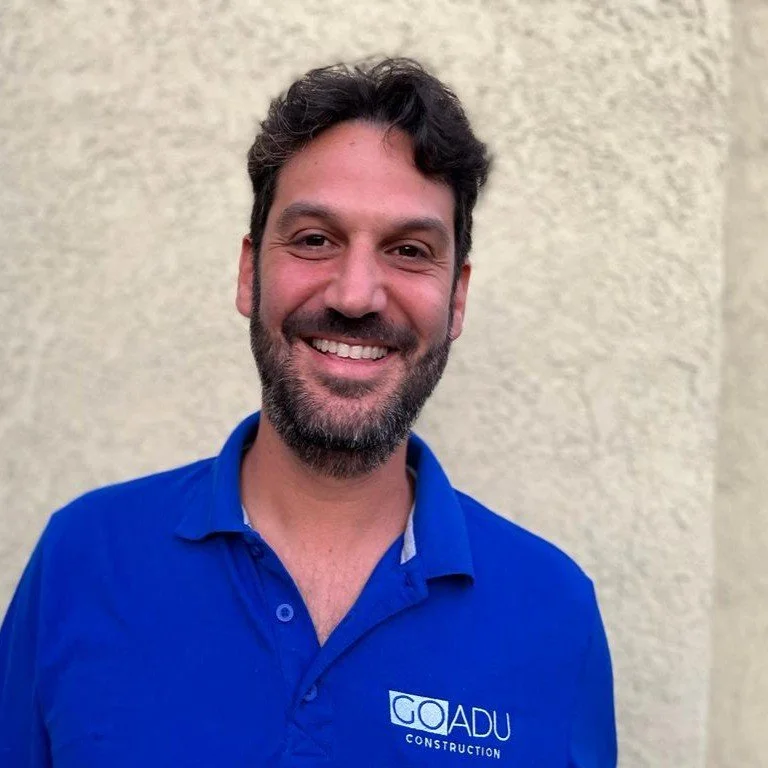
Gil Vaisman - Founder of GoADU
In this episode, Gil and I explore how he went from a 15-year career in film editing to building a construction business that helps homeowners unlock equity and create new living spaces.
Have a Listen
Summary
In this episode I’m joined by Gil Vaisman. He’s the founder of GoADU, a construction company focused on building accessory dwelling units.
We explore how he went from a 15-year career in film editing to building a construction business that helps homeowners unlock equity and create new living spaces.
What started out as a personal project in his own backyard turned into a growing business built through trial, error, and constant iteration.
Gil shares how he tested his way into the market, from helping friends navigate permitting to evolving into a guaranteed fixed pricing model. We also dig into how he qualifies customers, avoids costly mistakes, and thinks about what to test next in an industry that’s rapidly changing.
If you’re trying to turn a personal pain point into something scalable, this episode is a great look at how testing can lead to a viable business.
Enjoy my conversation with Gil Vaisman.
Takeaways
Great businesses often start as personal pain points
Gil’s ADU company emerged from building one in his own backyard and helping friends navigate the same confusing process.
Transferable skills matter more than industry experience
His background in film production translated directly into construction, both require coordination, budgeting, timelines, and managing complex teams.
Early traction came from education, not selling
In the beginning, most customers didn’t even know what an ADU was, growth required teaching the market before capturing it.
Trial and error built the real expertise
Navigating difficult permitting processes and making costly mistakes early on became the foundation for a repeatable, refined system.
Pre-qualification is critical in complex services
Gil now asks 20–25 upfront questions before taking on a client, ensuring alignment and reducing downstream risk.
Competing on price is a starting point, not a strategy
The business initially won work by being the cheapest, but evolved into a premium, top-20% offering focused on quality and service.
A strong value proposition can reduce industry fear
Guaranteed fixed pricing became a key differentiator, directly addressing customer anxiety around hidden costs and change orders.
Future innovation is constrained by feasibility, not demand
Customers clearly want faster, cheaper builds (prefab, SIPs), but adoption is limited by execution risk, expertise gaps, and inconsistent quality.
Guest Links
GoADU: https://www.goadu.com/
Vaisman Construction: https://www.vaismanconstruction.com/
Transcript
David J Bland (00:01.582)
Welcome to the Podcast Gil.
Gil Vaisman (00:03.675)
Thanks for having me.
David J Bland (00:05.838)
I'm excited to have you on. It's a topic I want to learn more about and you are one of the experts in it. And it's about construction and we haven't had a lot of shows about construction. So before we dive in to the actual testing of the nuances of everything, could you give people a little bit of background on yourself and how you got into this industry?
Gil Vaisman (00:24.005)
Yeah, absolutely. So I come from a separate career in film. I was a TV editor for almost 15 years, went to film school. So that's my background. And like I was a freelancer. And that's the one thing that
Sounds good on paper, but once you start having kids and mortgages, it's an uncomfortable place to be not knowing where your next gig is going to come from. And also you're capped in your upside based on how many hours you can work with because you're exchanging time for money. And so I loved what I did. I still love it.
but I had to find a business and it found me. I searched for a lot of businesses. I almost got into property management, short-term rentals. My dad was an entrepreneur and I had that spirit. almost opened a hedge fund at some point and
At the end, it was right in my backyard the whole time. 2017, we built an ADU with my wife. We were at the top of the budget. We bought a house for pretty much as much as we could lend. And we had the ADU as a way to pay for that mortgage. And it was paying for the mortgage.
And we were talking with friends that would come to our house and say, what's this thing in your yard? And I it's an ADU. You should do one. It makes sense. You have the land. It's already paid for. And so we were helping people out with how to navigate the permitting and finding a contractor and how to do this process from our experience.
Gil Vaisman (02:43.813)
And a couple of years later, like I realized that like I could try to market myself as this ADU guide, this ADU expert and provide the services to clients. And that's how we got launched the end of 2020, middle of the pandemic. And my plan B, which was this go ADU business.
With time, it became my plan A and now it's what I do full time. I don't have to work freelance editing anymore. It's been a few years now and I'm really happy about it.
David J Bland (03:22.795)
I love that winding history. I myself also have a winding history. I do think it's always interesting to me when I interview people, what are the similarities between industries that seem very different at the surface? So is there anything from film editing, anything from the skills you were using there in freelancing that you find, yeah, this actually kind of applies here too.
Gil Vaisman (03:45.54)
Absolutely. At the end of the day, both are like the production of a documentary or of a TV show, which is what I was doing. And the building of a structure are incredibly similar. One happens on media.
Like the product that gets shown on a screen, the other one you can sleep on and live on, but like they both require a set of plans, which is a script. They both require different departments and teamwork, which is subs and your own production team, which is your laborers and your production manager, which is your project manager and your.
trying to meet a budget and you're trying to meet a timeline. And in both, you need to coordinate all the moving pieces. So my background in film production, I feel like anybody that has done line producing could become a construction project manager in a heartbeat.
David J Bland (05:01.149)
I love that, I love that. And for those of you, we have listeners all around the world that don't understand what an ADU is. It stands for accessory dwelling unit. Could you give them like a high level of what that is before we jump into all the processes of testing around it?
Gil Vaisman (05:16.707)
Absolutely. ADU, also known as an accessory dwelling unit, and I know this by heart already. So it's easy for me to answer this one. It's also known as a granny flat and in-law suite or a guest house. It's an independent living structure that can be attached or detached from your main home. And it's a secondary dwelling that exists in your lot.
laws in many states and in many cities allow you to have that secondary dwelling in a single family zoned residential lot. locally here in California, we've had this law since 2017 that become more popular. As recently as last month, they passed laws in New York City allowing this to happen.
and it's becoming more more popular throughout the country.
David J Bland (06:20.791)
So what are some of the things that people, maybe you personally experience as issues and just confusing pains that you're dealing with when you try to build one of these? What was it that drew other people to you as beginning to be the expert in this topic?
Gil Vaisman (06:40.721)
having been there from the beginning, as soon as the law passed, I was like, I gotta get my hands into one of these. And I started my first experience was, was in a, in a tough jurisdiction. here in SoCal, the city of Vallejo is the easiest city. It's the most streamlined. they have the most resources, smaller cities like, Pasadena.
Burbank, Culver City, Beverly Hills, Santa Monica. The small cities are a pain in the behind to work with. They don't have the resources. They Mickey Mouse you with everything. And I was in the city of Burbank, which is notoriously difficult to deal with. So I was put through the fire. My first experience going as an owner builder,
hiring a draftsman, not even an architect to do this. I was put through the wringer and the lessons that I learned were expensive and personal for me. And so every time that I would repeat this process with a friend or with a client, I started accumulating experience in what not to do. And
especially with a process that was new, that was something that was unproven. Their only way to know it is by repetition, trial and error, and having a growth mindset of mistakes are learning opportunities.
Right now I ask 20, 25 questions before I sign anybody. And if I don't go through that questionnaire, we're not going anywhere because like I already know that we need this things figured out before we lay the ground.
David J Bland (08:47.713)
Wow, that many questions. I'm wondering, you know, what were some things that you tried that you thought would work early on that just went a bit sideways and didn't end up how you thought, but at least you learned and maybe it became a question.
Gil Vaisman (09:03.419)
For example, for the permitting process, I work now with about five different architectural firms, designers. And I work with a team that is a draftsman or a designer. It doesn't have to be an architect. You don't need a license to do it.
But you need to know what you're doing. You need to have experience in that jurisdiction with that city's code and each city has a different flavor. It's still gonna be a chocolate cake, but like one might have raisins, one might not. having that experience and then we use expeditors as well. Someone that just their job is to navigate the bureaucracy of the city.
to deal with it specifically. That goes a long way. In some cities, we develop relationship with the plan checkers and with the people in building and safety. They already know like, okay, it's coming from GoADU. We know they might not know everything that they're doing, but they're trying their best. And so we give them the benefit of the doubt.
David J Bland (10:22.156)
That sounds pretty accurate to me, just dealing with different places where we've lived in California. I think it's interesting to me that this came out of a personal problem that you experienced. You navigated it, and then people came to you. They, hey, what's that thing in your yard? And you start sharing it, and then they get interested and you help them. At what point did you feel as if, this could actually be a business?
Gil Vaisman (10:50.937)
it was, it was my wife. I was, I was doing DBAs left and right. I had a, a corporation and I was filing for DBAs every month with my brightest idea and designing the website and, and doing all that. And she said like, this ATU thing, like going to construction, go into.
It was 2020 was the year and I had like, that's when I actually incorporated because like you, couldn't use my corporation for, for that I used for media as a DBA for construction. needed a new corporation because I needed to get a license. And so I needed to pass the test. I had enough experience doing owner builder projects and I had enough flips under my belt.
to qualify for the five years experience that you need as a foreman. So that I had it. It was the learning how to pass the test for the contracting test here in California. Like not everybody can just like get a contractor license, but I got my own. And it was around 2020 when I realized that like
this could be a service that has enough demand, has enough growth to give it a good run. I don't believe every business, like I don't believe my line of business is gonna be necessarily around in 50 years, like we're gonna have to pivot at 10, 15 years at some point in the future. But...
If I get 10, 15 years of a profitable business, I'm a happy camper. I'll pivot and I'll leave something else for my kids by then.
David J Bland (12:50.996)
Yeah, I agree. think 2020 was such a weird year too. And we bought our house in 2020 and it was such a surreal experience. know, the home inspector wouldn't even let us, you know, be there. And shocker, we're still finding things wrong with our house today. It's like, we'll just do it on Zoom. And it's like, okay, okay. But how much of that do you think is timing? know, like we're ADUs.
Gil Vaisman (13:08.123)
Ha
David J Bland (13:19.34)
becoming more popular because of what we were doing, you know, going through with the pandemic. What's your take on that?
Gil Vaisman (13:25.809)
Yeah, ADUs definitely, before we would advertise for guest houses or granny flats or in-law suites, we needed, we were basically educating people on what you can do with your lot, know, like, hey, here's an opportunity to mine your property. Unfortunately, people with equity need...
think that they need to either sell their house or going to debt to get access to their property, to their equity. And we showed an alternative and it was a lot of education and a lot of, you can keep your house, gain equity, gain cashflow and gain room for your future. Maybe your kids, maybe your aging parents like.
you can rent it now, maybe rent it later. We have Volk, but it's an asset that's gonna be there forever. And the equity, whatever number you take out, you're gonna make it up in your property value going up. So it was such a no-brainer, but at the beginning, there was a lot of education. People weren't aware what that is. Nowadays, I would say the last three years,
It's become so popular because everybody has a neighbor that has done it or a friend that has done it. That the term that the word ADU rings a bell with everybody that lives in California. Like you don't need to translate it anymore. now I'm starting to do this like podcasts and then going out and my audience is a little wider. So now I'm going back to the days where I had to like do this.
basic education of like, you can do this. It's not a matter of whether you can or can't, it's a matter of what haven't you done it yet. like financially it makes great sense for people that like have that value, like are rich on paper, but they just don't feel that rich on a day to day world. They're struggling to.
Gil Vaisman (15:39.954)
to make it to the end of the month. And all of a sudden, you can tap into that equity. It's an outstanding opportunity that it's such a win-win and then macroeconomically as well, it's a part of the solution to the housing crisis. So it's such a net positive that it was easy to get behind.
It was easy to be enthusiastic about ADUs because I felt like it was such a positive change for everybody that like it's truly a victimless crime.
David J Bland (16:23.296)
Yeah, also culturally, it's really interesting here in the States, you know, having traveled abroad a lot that it's almost like we have our core nuclear family and then we don't necessarily have extended family living with us, you know, it's not culturally the norm, whereas other.
other parts of the world. mean, of course you would have your extended family nearby or with you. And it's really interesting to see people like, I do actually want my parents as they get older to be nearer to me or things like that. And I feel like maybe culturally that's shifting also a bit in the country where it's like, no, they don't have to live in a retirement home really far away. Like they could live with us nearby. And so I'm wondering, are you seeing some of that shift as well?
Gil Vaisman (17:02.285)
Absolutely. Originally, we would see mostly immigrant clients building ADUs for family members. So it used to be people from Asian countries, Latin American countries, where you traditionally keep your family at bay.
that used to be the core of the non-rental unit clients. But now more and more we're starting to see the American people like doing it for, especially for their sons. We're starting to see more the...
the older parents like with adult children that they cannot afford a starting home. And they're like, you know what, like I want you to be independent, but I'm not ready to kick you out yet. So what if I moved to the ADU and you stay in the main house and the...
And we're seeing that a lot. of course people want to get the brand new ADU. it's the price and then see who stays where. like people just doing that switch, that inheritance, they're doing it in real life. it's like, again, it's a great point you brought up, but it's another net positive that I feel.
which is keeping extended families together for longer. know, like grandparents get to experience what it's like for their grandkids, you know, which is, I feel a beautiful tradition from, I grew up with my grandmother in the neighborhood. She would cross the street and be there for us. And then she would come to every vacation and grandma was part of the family. That's how I grew up.
Gil Vaisman (19:18.853)
It wasn't an ADU situation. We were literally neighbors, but I grew up in Colombia and the Colombian Jewish and the grandma was like, you moved where your family was at. That's how my family ended up in Colombia from Europe in the first place. was like, know a cousin, come move with us. We know someone, come move with us.
So I find that to be so enriching to having your family nearby.
David J Bland (19:55.787)
Yeah, similar. grew up in a different area of world. I grew up in rural Appalachia and it was like our house. And then we had a little garden, well actually quite a sizable garden next to us where it was my aunt and uncle. Next to them was my grandmother, grandfather. Next to them was my great aunt. And then we had our little church there. It was, I look back and I was like, you know what, that's not.
common anymore, you know, that you have family surrounding you that way. And of course, now, you know, I'm living in California and it's a different situation. But I really I think back to those memories of I'll just walk to my grandparents house, you know, and have breakfast with them and everything. And I do think culturally, I just think it's interesting the space you're in. You know, you started around 2017 when the laws were changing, allowing this in California. Twenty twenty, the pandemic hits. People are looking for different.
accommodations. also have immigrants coming in and bringing their extended family sort of worldview of we want them near us. And then, you know, you sort of your American neighbors look at that and say, that that looks like something that maybe we should do that, you know, and I feel like there's a lot of things working in your favor here, maybe not zoning laws aside. And, and the mess that is, I was curious, when you were talking about this, you mentioned before we got on the podcast about
Gil Vaisman (21:09.755)
You
David J Bland (21:18.572)
pricing and how these things are sold. Tell me a little bit about how you're approaching that, how you're trying to test different models and what you're learning so far from that.
Gil Vaisman (21:31.118)
Okay, so it's been an evolution because originally when you're starting you have to have a competitive edge. Like I have five bits from five different contractors. Who should I hire? And most people go with that person that is most experienced.
And when you're starting and you don't have that track record to begin with, your competitive advantage is, I was the cheapest. So that's how we got started. We barely made money in the first ADUs we built. We had to compete on price. We had to fight our way to those people that were budget conscientious, which are now...
knowing what I know and having been through what I've been through, some of the people with the lowest budgets tend to be the pickiest. And I had to put up with a lot of that and projects where I was just like, I'm hoping I'm not going to lose money on this one.
But like I marketed the living crap out of every opportunity that I had. I took pictures of everything, made sure that the finishes were Instagram worthy and started leveraging that very quickly to go to the position where we can position our brand to what we are right now, which is a top 20 % of the market.
If you are looking for the cheapest, we're not your fit anymore because we offer a product that like offers some guarantees, white glove service, and that involves that we need to price ourselves out of that person that is is looking for budget and budget is the most important thing for them. We're not a fit anymore.
Gil Vaisman (23:43.01)
And we've evolved out of it, which is a different value proposition. There's a famous triangle, which is I want it fast, I want it cheap, and I want it good. And everybody knows this. It's across every industry. You got to pick two out of the three. it just, the perfect equation of getting all three of those, it's just not possible.
So we're not the cheapest and we know we can be good and we know we can be fast, but that involves losing a lot of potential customers because they are more budget conscientious and it's a compromise that we're comfortable with now.
David J Bland (24:33.033)
Yeah, I see that you, as you learn, your segments do change and you don't always stick with those early customers, you know, as you evolve the business. You mentioned something before we got on the podcast, which was this idea of a guaranteed fixed price. Can you tell me a little bit about that and how you tested that and what you learned from that?
Gil Vaisman (24:51.312)
Yes.
Gil Vaisman (24:56.945)
Yeah, it's, um, I read it in a book about marketing and the example that they give us the example on, uh, of CarMax, how CarMax wanted to revolutionize the car selling industry by providing all the scary stuff that used car salesmen brought to the equation. So
When I got into the construction industry, I saw a lot of scary stuff and you would talk to people and the fear is change orders, contractors changing the price mid-bill. It's like, but wait, there's a surprise here. Now you need to pay for that as a client. whatever we discussed is not. And I found that like, it was kind of culturally accepted. People were.
Like a lot of clients, would try to educate them like, Hey, I'm not going to be the lowest, like everything's included here. This, this super low price you're hearing is going to come with surprises and most clients just run through that red flag and they were like, no, I want that super low price. They, they promised me that and they're on for a terrible experience in terms of.
of just, it's not pleasant. It's not a pleasant way to do business. So I try to tackle that head first by being extremely thorough, making the assumption that things will go wrong, price that in, and offer that peace of mind. like the last Google review we got, like I love it. I show it to clients because
They mentioned that like we stuck to the price to the cent. The number we gave them was the number they paid. No surprises, guaranteed pricing. If you don't change your mind, we're not going to change our price.
David J Bland (27:05.551)
Wow, so that almost feels as if, you know, in a world where people are trying to compete with the same, like that might be your, one of your unique value propositions, you know, that we have this guaranteed fixed price, we know what we're doing and there aren't going to be any surprises. I think I like how you modeled it to like CarMax, but for ADUs in a way.
Gil Vaisman (27:30.907)
Yeah.
David J Bland (27:35.261)
So how was your conversion rate on those? Like how did people respond to when, cause that's a very different experience. Like going into CarMax first time, well, I can't remember if I've sold cars to CarMax, I've not purchased one there, but I remember it was a very different experience walking into a CarMax lot versus other lot. what was it like, like what were the, what were the conversion rates when people were, you were interacting with them, pitching this for the first time?
Gil Vaisman (28:00.856)
So our conversion rate is in construction conversion rates are typically anywhere from 10 to 20 percent. Like if you're above 15, you're knocking out of the park. We're right about the 17 percent of so out of every seven people that come to knocking on our door, we're going to end up with one client, which I think it's pretty good.
because just by how we position ourselves as a brand, our customers are only 20 % of the entire people that are gonna build an ADU. So out of 10 people that are gonna build an ADU, you have your owner builders. They're not even gonna hire a contractor. They're gonna hire subs directly. That's a percentage. Then you have people that are like...
want to save as much as they can. They'll take a non-licensed contractor. They'll take a handyman. They'll take whatever they can to save some money. That's another percentage. And so the people that are our people, which is people that like have had typically experience with another contractor and know all the tips and tricks and are ready to like not do that again and are vetting the
exhaustive like really vetting every contractor that it tends to be one out of five one out of five are not going to go for the lowest bid because they know they know already and the so like if we're come like so my
best case scenario that the like statistically speaking is 20 if I'm converting 20 % that's like batting 300 that's 90 % from the free throw line that's that's amazing so I think we're doing pretty well now
David J Bland (30:05.418)
It sounds like I like how you broke it down in different sub segments out of the overall segment. What, if you can share, what gets you excited or is there something you want to test that you haven't tried yet in this industry? Granted, you've been in it for a while now and it's still an evolving industry. Is there something you want to test, like something maybe different that other ADUs don't do?
Gil Vaisman (30:28.187)
Yeah, yeah.
Gil Vaisman (30:32.697)
Yeah, we have always been fascinated by prefabricated and they're called SIPs. So one day want to get into that. Like it's this new technology that allows you to prefab. The problem has been that the
Either it's a higher price for a good quality, but like you don't end up saving money over stick build or it's horrible quality for a cheaper price. Like we still haven't found that person that like can get us a good price for the top quality. But the moment we find it, like I'm jumping ship. I'm trying to sell prefab as much as I can, because I believe that there are inefficiencies in the way we're building today, bringing the materials to the side.
to then work on site, conceptually prefabricated makes sense. Practically, we haven't gotten there yet and it's been a process of decades until like someone will crack that code and I wanna jump into it when that happens. And the other process, it's called SIPs. I forgot what it stands for, but like it's this models where you basically pour
the wall and the insulation all at once and you basically skip framing. Like it allows you to, to accelerate the building process by like 30, 40 % and cost wise, like, but it's hard to find people that know what they're doing with this process because it's so new. But the moment that like,
Like we'll jump ship and do things that way instead of how we're doing it right now.
David J Bland (32:24.604)
I like that you have some things you're excited about. I'm wondering, so from a theme perspective, you know, what we normally do is we kind of frame this as desirability risk, which is like risk around the customer and the market and the jobs to be done and all that and your value prop. The viability risk is usually on cost and revenue.
willingness to pay, all that. And then feasibility is just like, can you do it? Is it technically feasibly possible? Is it gonna violate any regulations or anything? It almost sounds as if the risk on some of these is more like backstage risk of, it's just, either there's not a lot of people that know how to do this or do it well, or maybe a little bit of viability risk where it's just really expensive to do. It feels the desirability isn't necessarily the riskiest thing there.
Gil Vaisman (32:50.992)
Yeah.
Gil Vaisman (33:15.043)
No, not at all. Who wouldn't want to be able to save money and save time? It's a no-brainer if you're not compromising the quality, if the structure is going to be well-built. We're having these technologies for commercial projects mostly, where bigger, more experienced builders are
jumping ship already but...
I'm looking forward to because I have made a few phone calls to people that know how to do it and they're like you need all the certifications you need to know how to do this and then there's the fear of like I don't want to be the guinea pig to maybe it's not as viable you know.
David J Bland (34:17.639)
Yeah, I would say in the art of kind of like starting small, like what's a small test you could do, but not risk your brand in doing so, because I mean, your brand is everything and you don't necessarily want to word of mouth, especially in construction, I imagine, can get around. But I'm glad you're excited about that. That's cool to hear. So we've covered so much in this conversation so far with...
starting in film, I knew a little bit, but I didn't know the extent of you working in film, how that transferred over finding this niche with ADUs and how you've learned and grown that business over time. If folks are listening to this and they want to learn more about what you do and they want to learn how to get in contact with you, what's the best way to reach out?
Gil Vaisman (35:04.995)
Okay, easy. I have two companies. One is GoADU website is GoADU.com. Parent company is Vaisman Construction. We also build single family homes under that umbrella because it doesn't have GoADU in the name. And I'm available also like Gil Weissman.
hit me up, send me a DM, whatever, we'll answer. I'm not that popular yet. hopefully this one day I'll have a team of people answering, but right now I'll answer.
David J Bland (35:51.753)
You're not popular yet, yet. Maybe after this episode, you'll be much more popular. I want to thank so much for hanging out with us, talking about some of your evolution in this and how you kind of tested your different pricing models and what you're going to test in the future, what you're excited about. I really appreciate you hanging out with us today,
Gil Vaisman (35:53.741)
hahahaha
Gil Vaisman (36:08.859)
Nah, it was a pleasure, man. It was really a fun conversation.