Net Promoter Score or Product Market Fit Survey?
Over the years I’ve found that mentioning Net Promoter Score elicits a strong reaction from product and business owners. Some love it, others hate it. Experts have built an entire career on it.
I’m not here to debate the pros and cons of Net Promoter Score (NPS), but to show you how I’ve found a simple way to help you make it more effective.
One of the common mistakes I’ve seen with NPS is that it is used at the wrong time. Combine this with the fact that it is also a lagging indicator and you get not only misrepresented information but you get it, way, way too late.
Enter the Product Market Fit Survey.
I affectionately call this survey the Sean Ellis test because I learned it originally from Sean Ellis. He coined the term “growth hacking” and has been influential in my career with regards to how I approach product market fit.
The format of his survey is generally as follows:
“How disappointed if you could no longer use [insert product here]?”
Very
Somewhat
Not at all
Here’s an example below:
The goal of this survey is to better understand if you have fit with your current customers. Ideally you have a score of at least 40% because you’d want them to feel very disappointed if your product went away.
But it doesn’t make sense to show your customer this survey right away!
They need to have experienced the core value proposition of your product recently, and preferably more than once.
Here’s the workflow I used to illustrate this in Testing Business Ideas.

Source: Testing Business Ideas pg 280
If they’ve not experienced the core value proposition recently and more than once, then it is better off to use something else such as a discovery survey. You’ll want to a call to action as well so that you can perform customer interviews to better understand why they signed up.
A sign up tells you the “what” (quantitative) but until you interact with them you don’t know the “why” (qualitative).
If people answer “somewhat” or “not at all” to the disappointed survey question, then it doesn’t mean you just pack your things and give up. This is where the real work begins! You’ll need to segment them into groups and start to dig in to why they feel this way. Reach out to them and interview them if they are open to it. Look at where they came from as referral sources. Start to better understand why the value proposition of your product is not resonating with them.
I illustrated it in Testing Business Ideas this way:

Source: Testing Business Ideas pg 280
Now, let’s talk Net Promoter Score.
Net Promoter Score (NPS) is all about gauging how likely customers will refer you to other customers. Basically if they do so, it’ll be an engine of growth for you and save you money on paid acquisition.
An example format of NPS would be:
“How likely is it that you would recommend this product to a friend or colleague?”
Not at all 0 1 2 3 4 5 6 7 8 9 10 Extremely
Here’s an example below:
There is much debate on what a good NPS score is depending on industry, trends and such but basically you are looking at the following calculation:
% PROMOTERS - % DETRACTORS = NPS
Here’s how I depicted it in Testing Business Ideas:

Source: Testing Business Ideas pg 281
Unfortunately even with all of this guidance, teams still find themselves in this situation:
You: “How likely would you be to recommend this product to a friend or colleague?”
Customer: “Oh, extremely!”
You: “Awesome! Wait a minute, would you be disappointed if the product went away?”
Customer: “Nope, not at all!”
*awkward silence
And this situation happens all too frequently because we aren’t using the appropriate forms of customer research in the correct sequence. You also need to go way beyond surveys but I digress.
I recommend that you ask NPS after you’ve found product market fit, which you can help diagnose using the Sean Ellis Test.
The flow goes something like this:
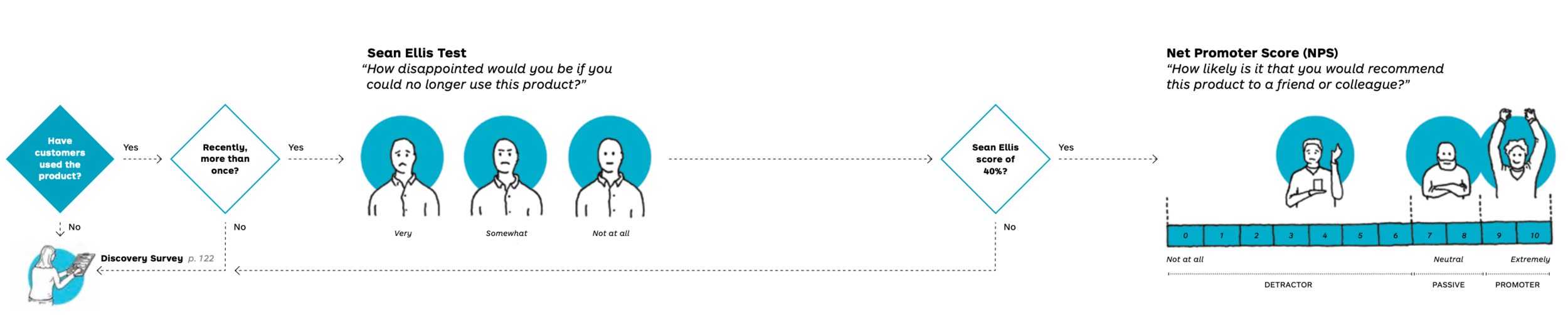
Source: Testing Business Ideas pgs 280 - 281
If your customers have experienced your core value proposition recently and more than once, then use the Sean Ellis Test to determine fit. If they aren’t disappointed if your product went away, then dig in to find out why. If they are disappointed then you can use a Net Promoter Score survey later on to gauge if they are likely to recommend your product to friends and colleagues.
And the work doesn’t stop there.
If they are likely to refer, then make it easier for them to do so! Experiment with referral programs and make them ambassadors for your product to the market.
Hopefully with these minor tweaks to how you sequence your experiments and discovery process, you’ll be dialed in to your customer in no time.
Besides, nobody wants to have customers who don’t care if your product is going away, but will tell all of their friends about it.